
Home / White Card (EEOICPA)
Helping Hanford Workers Access the Care and Benefits They Deserve.
If you or a loved one worked at the Hanford Site and developed an illness related to workplace exposure, you may qualify for benefits through the White Card Program (EEOICPA). This federal program provides eligible workers with medical benefits and compensation for accepted work-related illnesses.
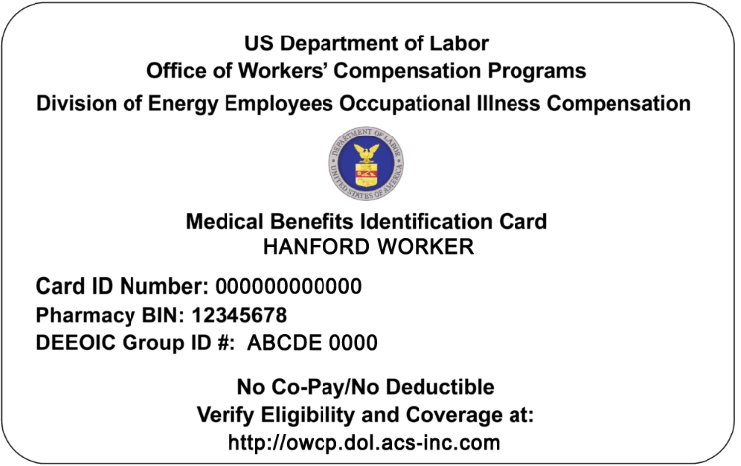
Sample White Card · For illustration only
For decades, thousands of workers dedicated their careers to supporting operations at the Hanford Site. Many may have been exposed to radiation, beryllium, silica, asbestos, solvents, and other hazardous materials on the job. Today, many former workers and their families are living with serious health conditions that may be connected to that work.
If you or a loved one worked at Hanford and have been diagnosed with cancer, a respiratory illness, or another occupational disease, you may be eligible for federal benefits, compensation, and medical care through the White Card Program (EEOICPA).
You do not have to navigate the process alone. Our team can help you better understand the program, your potential benefits, and the next steps available to you.

Did You Work at Hanford?
Whether you worked for the Department of Energy, a DOE contractor or subcontractor, or another covered employer at the Hanford Site, your employment history, work location, job duties, and dates of employment may be important in determining eligibility.
Many former Hanford workers may not realize that benefits could still be available years after they stopped working or retired.
- Operations and production workers
- Maintenance and craft workers
- Construction trades
- Pipefitters, plumbers, and welders
- Electricians and electrical workers
- Equipment and heavy machinery operators
- Laborers and material handlers
- Security and protective services
- Firefighters and emergency response personnel
- Laboratory and technical workers
- Engineers and other technical professionals
- Administrative and support staff
- Environmental remediation and cleanup workers
Your job title alone does not determine eligibility. The type of employer, where and when you worked, potential workplace exposures, and your medical diagnosis can all be important when evaluating a claim.
Illnesses That May Be Associated With Workplace Exposure
Former Hanford workers diagnosed with certain illnesses that may be related to workplace exposures may qualify for benefits through the White Card Program (EEOICPA). Eligibility depends on employment history, diagnosis, workplace exposures, and program requirements.
Cancer Diagnoses
Hanford workers may have been exposed to ionizing radiation and other hazardous substances associated with certain cancers. Cancer claims are evaluated based on the worker’s diagnosis, employment history, workplace exposures, and applicable program requirements.
Some Hanford workers may also qualify through the Special Exposure Cohort (SEC).
Respiratory & Occupational Lung Illnesses
Exposure to dusts, fibers, fumes, chemicals, metals, and other airborne contaminants may contribute to occupational lung disease. Illnesses such as COPD, pulmonary fibrosis, chronic bronchitis, emphysema, pneumoconiosis, and other respiratory diseases may be considered depending on the worker’s exposure history and medical evidence.
Beryllium-Related Illnesses
Workers exposed to beryllium may develop beryllium sensitivity or Chronic Beryllium Disease (CBD). These conditions may affect breathing, stamina, and lung function and may qualify for benefits when applicable medical and employment requirements are met.
How the Program Could Apply to You
Many former Hanford workers associate the White Card primarily with cancer and may not realize Part E can apply to other occupational illnesses caused by toxic workplace exposures. Here’s how each pathway works.
Cancer & the White Card
Certain cancers may qualify for benefits through the White Card Program (EEOICPA). Some Hanford workers may qualify through the Special Exposure Cohort (SEC), which provides a special pathway for eligible workers diagnosed with specified cancers.
For qualifying SEC claims, radiation causation may be presumed without the usual NIOSH dose-reconstruction process. SEC eligibility depends on factors including the worker’s employment dates, covered work location, qualifying workdays, and cancer diagnosis.
Workers who don’t meet SEC requirements may still potentially qualify for Part B cancer benefits through the NIOSH dose-reconstruction process, which estimates occupational radiation exposure and is used in determining probability of causation.
Part B Benefits
Part B provides benefits for certain radiation-related cancers, Chronic Beryllium Disease (CBD), beryllium sensitivity, and certain cases of chronic silicosis when applicable program requirements are met.
Eligible workers with a qualifying Part B cancer or Chronic Beryllium Disease may receive a $150,000 lump-sum payment, along with medical benefits for their accepted condition. Certain eligible survivors may also qualify for compensation.
Beryllium sensitivity is treated differently from Chronic Beryllium Disease. An accepted beryllium sensitivity claim can provide medical monitoring and related medical benefits, but beryllium sensitivity alone does not qualify for the $150,000 Part B lump-sum payment.
Part E Benefits
Part E provides benefits to qualifying DOE contractor and subcontractor employees who developed illnesses related to toxic substances encountered during covered employment.
These workplace exposures may include chemicals, solvents, acids, metals, radiation, and other hazardous substances. Part E can apply to a broad range of occupational illnesses when workplace exposure is shown to have caused, contributed to, or aggravated the illness.
- Medical care for accepted conditions
- Impairment compensation
- Wage-loss compensation
- Survivor compensation
Eligible employees may receive up to $250,000 in Part E monetary compensation based on impairment and/or qualifying wage loss, in addition to medical benefits for accepted conditions.
What Your White Card May Cover
Once an illness is accepted under the White Card Program, medical benefits may cover reasonable and necessary care related to that accepted condition.
Home Health Care
This is where At Home Staffing comes in. When home health care is medically necessary and authorized through your White Card benefits, the program may cover approved in-home services, including skilled nursing, home health aide support, and assistance with activities of daily living.
Once approved for home health care through your White Card benefits, your authorized care is provided at no cost to you, allowing you to focus on your health and remaining safely at home.
Many former Hanford workers want to remain in the comfort of their own homes rather than move to a facility. Home health services can help eligible individuals remain safe at home, maintain independence, receive assistance with daily activities, and improve their quality of life while also providing additional support for their families.
At Home Staffing understands the unique needs of former Hanford workers and their families. Our team provides compassionate, dependable care while helping coordinate authorized home health services through the White Card Program.
Impairment
If your work-related illness has left you with a lasting impairment, Part E may provide compensation based on the severity of that impairment. This is separate from medical benefits and is based on the percentage of whole-person impairment caused by your accepted condition.
Compensation is $2,500 for each percentage point of impairment. Our team can help you navigate the impairment rating process, including completing forms, gathering medical records, and coordinating the documentation needed for your claim.
Durable Medical Equipment (DME)
Medically necessary equipment and supplies related to an accepted condition may be covered through the White Card Program. This may include oxygen equipment, wheelchairs, hospital beds, and other approved medical equipment and supplies.
Our team can help patients and families coordinate with their medical providers when documentation or authorization is needed.
Treatment, Medications & Other Benefits
White Card medical benefits may include physician care, diagnostic testing, hospital care, prescription medications, and other medically necessary treatment related to an accepted condition.
Additional medical benefits may also be available depending on the individual’s accepted conditions, medical needs, and program requirements.
At Home Staffing proudly offers a Family Caregiver Program for eligible White Card (EEOICPA) clients, allowing qualified family members to become paid caregivers while providing compassionate care to their loved ones at home.
Family caregivers must meet applicable employment, training, and program requirements.
This page provides general information about the EEOICPA program and is not legal advice. Benefits vary by claim.
You May Be Able to Add Additional or Consequential Conditions
Receiving your White Card doesn’t necessarily mean your claim is complete.
If you develop another illness that may be related to your Hanford workplace exposures, you may be able to file a claim to have an additional condition accepted.
You may also develop a consequential condition — a medical condition that develops as a result of, or is aggravated by, an already accepted work-related illness or its treatment.
For example, an accepted illness or its treatment may contribute to additional medical problems that require further care. When supported by appropriate medical evidence, these conditions may also be considered for coverage under the White Card Program.
At Home Staffing can help you navigate this process, including gathering medical records, coordinating with your physicians, and helping you understand the documentation that may be needed.
We Can Help You Understand Your Options
Understanding the White Card Program and the benefits available to you can feel overwhelming. Whether you’re just beginning to explore your options, already have a White Card, or need help accessing benefits for an accepted condition, At Home Staffing is here to help you navigate the next steps. Our team can help:
- Review your Hanford work history and potential occupational exposures
- Help you understand White Card benefits
- Explain Part B, Part E, and SEC
- Assist with forms and supporting documentation
- Help gather and coordinate medical records
- Coordinate with physicians and medical providers
- Help with additional or consequential condition documentation
- Navigate the home health authorization process
- Coordinate authorized home health services
Every Hanford worker’s employment, exposure, and medical history is different. You don’t have to figure it out alone.
Let's Find Out What You May Qualify For
Answer a few short questions online — about three minutes. A member of our team will review your answers and follow up personally with next steps.